DEGATE / THE HANDBOOK

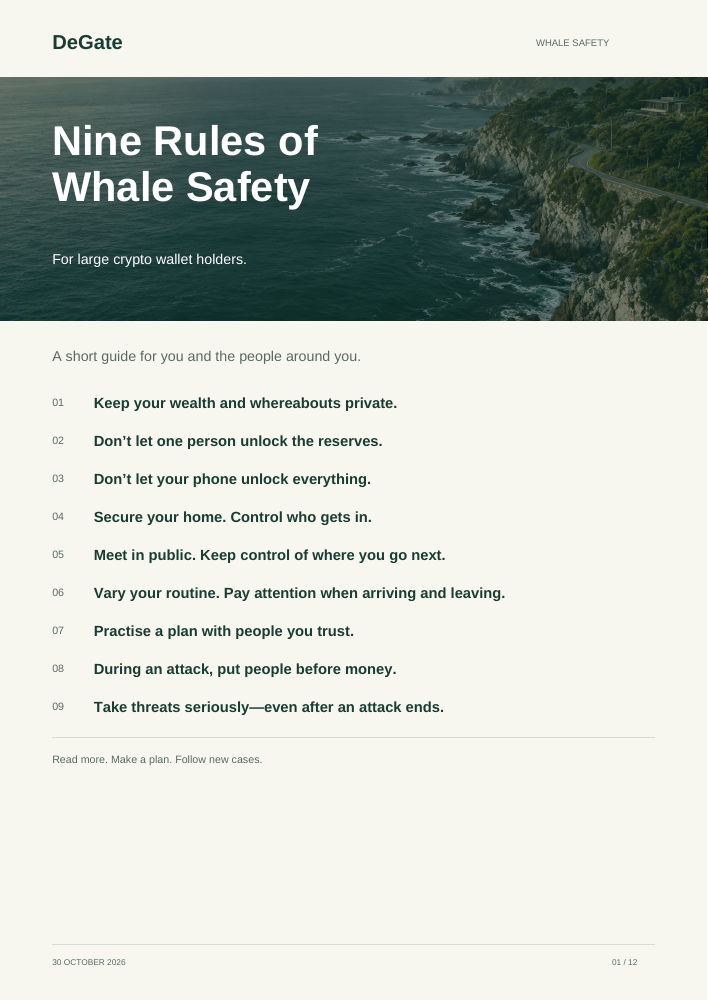
Nine Rules of Whale Safety

For large crypto wallet holders.

12 pages · Free to read and share
Nine Rules of Whale SafetyOPEN THE HANDBOOK

Nine rules. Everyday practice.

Choose a rule to read more

01Protect your privacy and assets

01

Keep your wealth and whereabouts private.

Ocean coastline; illustrative photograph

Share less about what you own and where you will be.

  1. Look at what others can see.

    Review public wallet links, interviews, home photos and live travel posts. Agree privacy boundaries with family and staff; consider information held by service providers, too.

  2. Share only what is needed.

    Someone arranging your car needs a pickup time, not your balance or full itinerary. Post trips after you leave.

  3. Plan for old leaks.

    Deleting a post does not erase copied data. If an account is breached, check whether it exposed your home or movements.

ONE THING TO DO

Check what your name, handle and recent posts reveal.

Why this matters & sources

A US sentencing account describes attackers using a compromised iCloud account to track a victim before a home burglary.

Read more
02

Don’t let one person unlock the reserves.

Illustration accompanying the rule

Build in independent checks that you cannot simply bypass.

  1. Separate spending from reserves.

    Keep routine funds available. For substantial reserves, consider independent approval and withdrawal restrictions with qualified help.

  2. Check the shortcuts.

    Include recovery keys, account resets and instructions to assistants. Another device or property is not independent protection if you can retrieve it or order access.

  3. Test recovery, too.

    Choose an arrangement you can maintain and recover if a signer or device is lost. Practise independent approval; recognising your voice does not prove you are acting freely.

ONE THING TO DO

Ask: what could I transfer, reset or have released on my own?

Why this matters & sources

In Minnesota, attackers forced a victim to another property for devices. Geographic separation alone did not prevent the theft. Transfer restrictions cannot guarantee personal safety.

Read more
03

Don’t let your phone unlock everything.

Illustration accompanying the rule

Carry only the access you need. Remember what the screen can reveal, too.

  1. Limit what the phone can reach.

    Keep everyday spending and unfamiliar apps away from reserves. Include your laptop, cloud backups and account recovery. Deleting a wallet app alone does not cut access.

  2. Protect the recovery routes.

    Secure email, cloud accounts and password recovery. Use passkeys or strong two-step verification where supported, with tested backups.

  3. Verify before acting.

    Check ordinary money requests through a separate, known contact route. Avoid showing balances or handing over an unlocked phone. A read-only portfolio can still reveal your wealth.

ONE THING TO DO

Imagine someone holding your unlocked phone. What could they see, spend or reset?

Why this matters & sources

Taiwan reporting describes a seller’s phone being seized after an account demonstration and used to transfer bitcoin. The exact account controls were not established.

Read more

02At home and on the move

04

Secure your home. Control who gets in.

A residential entrance; illustrative photograph, not a security specification

Strengthen the entrance. Agree what happens if it fails.

  1. Review the whole entrance.

    Have a qualified installer assess doors, frames, locks and reachable windows. Include garages and shared-building access; keep fire exits usable. Review your workplace and accommodation, too.

  2. Verify before opening.

    Use the intercom and an independently known contact. A uniform, your name or an expected delivery is not proof. Apply the same rule to hotel visitors.

  3. Know who responds.

    Lighting, cameras and alarms need a response. Practise where to seek safety, how to call for help and who acts on an alert—including when you are away.

ONE THING TO DO

Walk through an unexpected visitor scenario with everyone at home.

Why this matters & sources

A US indictment alleges that attackers posed as delivery workers to enter crypto holders’ homes. These are allegations, not convictions.

Read more
05

Meet in public. Keep control of where you go next.

A hotel lobby; illustrative photograph

A lobby, a private room and a car are different decisions.

  1. Choose a staffed public place.

    For people you are unsure of, choose a busy, staffed venue and arrange your own way home. Apply the same care to dates, introductions and business meetings.

  2. Treat a venue change as a new decision.

    An invitation upstairs, into a car or to an afterparty is a fresh decision. A referral or previous successful meeting does not make the next setting safe.

  3. Keep settlement separate.

    Avoid large-cash handovers and wallet demonstrations at introductory meetings. Use lawful, independently verified services; a successful small trade proves little about a larger one.

ONE THING TO DO

Set the exact venue, your return journey and a check-in before you go.

Why this matters & sources

The Tokyo hotel-room case and Singapore cash-meeting case show different problems: private access and cash exposure. A public location alone does not make a deal safe.

Read more
06

Vary your routine. Pay attention when arriving and leaving.

An airport walkway; illustrative photograph

Vary familiar journeys. Pay attention at arrivals and departures.

  1. Vary safely.

    Where practical, vary familiar times and routes while staying on sensible, well-used roads. Avoid creating a more isolated journey just to be unpredictable.

  2. Check the pickup.

    Match the vehicle and driver to your booking; knowing your name is not enough. Check your surroundings before getting in or out. Plan the return before a night out.

  3. Seek help if followed.

    Avoid going home or confronting the person. Seek a staffed, busy place and assistance. Share travel details privately with someone trusted.

ONE THING TO DO

Review the journey after your next meeting, not just the meeting itself.

Why this matters & sources

Personal-security guidance identifies arrivals, departures, vehicle entry and predictable journeys as moments to pay particular attention.

Read more

03Prepare, respond and recover

07

Practise a plan with people you trust.

Illustration accompanying the rule

Agree who notices, who acts and how to get help. Include someone outside the household.

  1. Choose the right people.

    Include trusted family, carers and staff as appropriate. If a partner, relative or business associate is threatening you, seek confidential support outside that relationship.

  2. Agree when someone acts.

    Agree visitor and child-pickup rules, check-ins and a backup contact. Rehearse what happens if you miss a check-in. Credible danger should not wait for a fixed deadline.

  3. Practise an unusual money request.

    A genuine voice can still be speaking under coercion. A code word is one possible signal, not proof of safety. Seek professional help when danger is credible.

ONE THING TO DO

Ask who would notice if you and your partner became unreachable together.

Why this matters & sources

In a Wuhan prosecutor account, a relative was forced to send a genuine voice confirmation. The remote holder then transferred USDT. Identity did not establish safety.

Read more
08

During an attack, put people before money.

Illustration accompanying the rule

Survival comes first. No wallet can promise your release.

  1. Protect life.

    Do not fight over property or attempt to disarm someone. Avoid sudden movements and seek help as soon as it is safe.

  2. Understand the duress-wallet limits.

    A separate wallet intended for surrender may not satisfy an attacker who expects more or suspects hidden accounts. There is no reliable universal amount or promise of release.

  3. Plan before a crisis.

    Discuss any duress wallet or alert system with a qualified adviser beforehand. People helping you should seek crisis advice before blocking transfers while anyone remains captive.

ONE THING TO DO

Keep “protect people” separate from “prevent a transfer” in your plan.

Why this matters & sources

The sources disagree on decoy wallets. Bankless questions their reliability; Hodlguard and SEAL discuss possible uses. None establishes a dependable way to make an attacker release someone.

Read more
09

Take threats seriously—even after an attack ends.

Illustration accompanying the rule

A payment, escape or release may not end the danger.

  1. Take the warning seriously.

    Act on threats, attempted entry or suspected following, including from people you know. Do not meet a threatening counterparty alone to settle a dispute.

  2. Get support from safety.

    From a safe place, seek medical care, police or specialist support as needed. Preserve evidence. Review where you stay and who can reach you; keep recovery arrangements private.

  3. Secure access and keep checking.

    When safe, review exposed devices, accounts, keys and recovery access with trusted help. Include psychological support. Be wary of unsolicited offers to recover stolen funds.

ONE THING TO DO

Choose a trusted contact and professional support before you need them.

Why this matters & sources

Greater Manchester Police documented repeated extortion and abductions of the same victim. Payment and release did not end the targeting.

Read more
About this guidance

Practical guidance for preparation. Whale Safety does not provide emergency assistance. Full sources are on the website; independent security-expert review is pending.

Published cases show how attacks happen; they cannot prove that any precaution would have prevented one. The wider incident register includes leads that have not been verified.

Sources & updates

Photographs: Josh Hild · Lennart Rudolph · Edward Howell / Unsplash. Illustrative settings, not incident photographs.

GO DEEPER
Case studiesIncident mapPlacesFurther reading
Report an incident
DeGate

Presented by DeGate.

Explore DeGate

Find your next step.

Search 50 cities, 54 chapters and ten case studies, or explore the incident register.

Search the full incident register
CITYDubai · United Arab EmiratesCITYAbu Dhabi · United Arab EmiratesCITYHong Kong · Hong KongCITYMacao · MacaoCITYSingapore · SingaporeCITYTokyo · JapanCASECher, France · Taken from home. Held apart.CASEParis, France · The family became the target.CASEHong Kong · A trade invitation became captivity.CASEPunggol, Singapore · A Telegram offer. A bag of cash.01Start here02Emergency numbers and bilingual card03Decide how much protection you need04Map your exposure without creating a target list05Reduce what strangers can learn06Separate daily spending from long term reserves07Make signing a deliberate activity08Backups and inheritance without new vulnerabilities09Secure phones accounts and communications10Recognise manipulation before money moves11Give family and staff a usable role12Make home entry predictable and controlled